> For the complete documentation index, see [llms.txt](https://docs.shprd.finance/llms.txt). Markdown versions of documentation pages are available by appending `.md` to page URLs; this page is available as [Markdown](https://docs.shprd.finance/guides/create-and-manage-a-vault/create-a-vault.md).
# Create a vault
Guide to create a vault.
When permission-less mode is enabled by the AccessManager contract, anyone can create a vault. When creating a vault, at least two tokens from the factory's authorised list must be chosen.
{% hint style="info" %}
The creator will have the right to **rebalance** the vault and **collect the fees**.
{% endhint %}
## How to create a vault
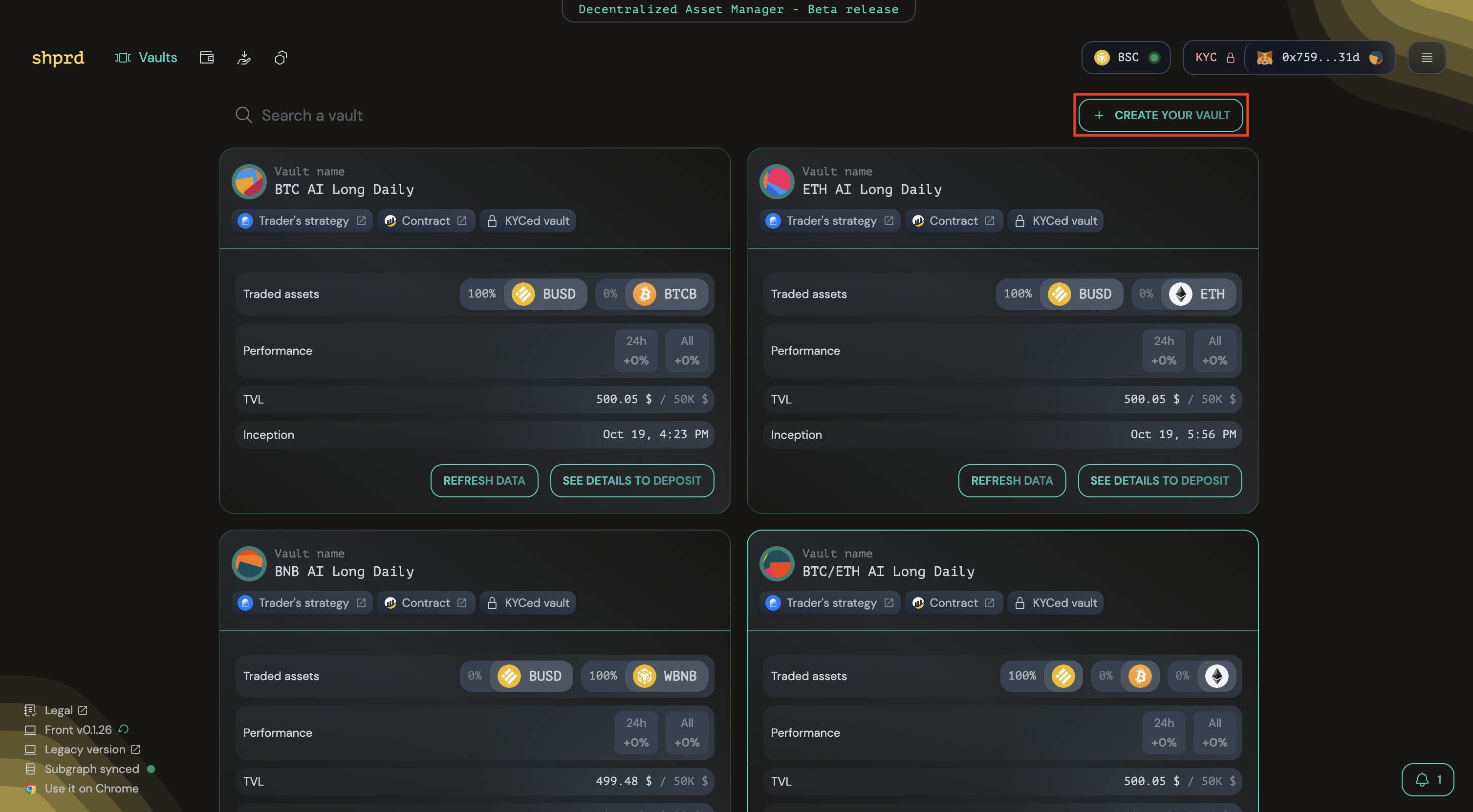
In the vaults section, click on "create your vault".
Vaults
In the first section, you can choose a **name** for your vault and add a **mirror** page url. Moreover, you also have to choose a **name** and a **symbol** for your **share**. As indicating in the app this two element are immutable. Therefore, you will **not** be able to modify them after their creation.
For the strategist, you have to put the **address** of the wallet which will **manage** the vault.
Vault creation - General
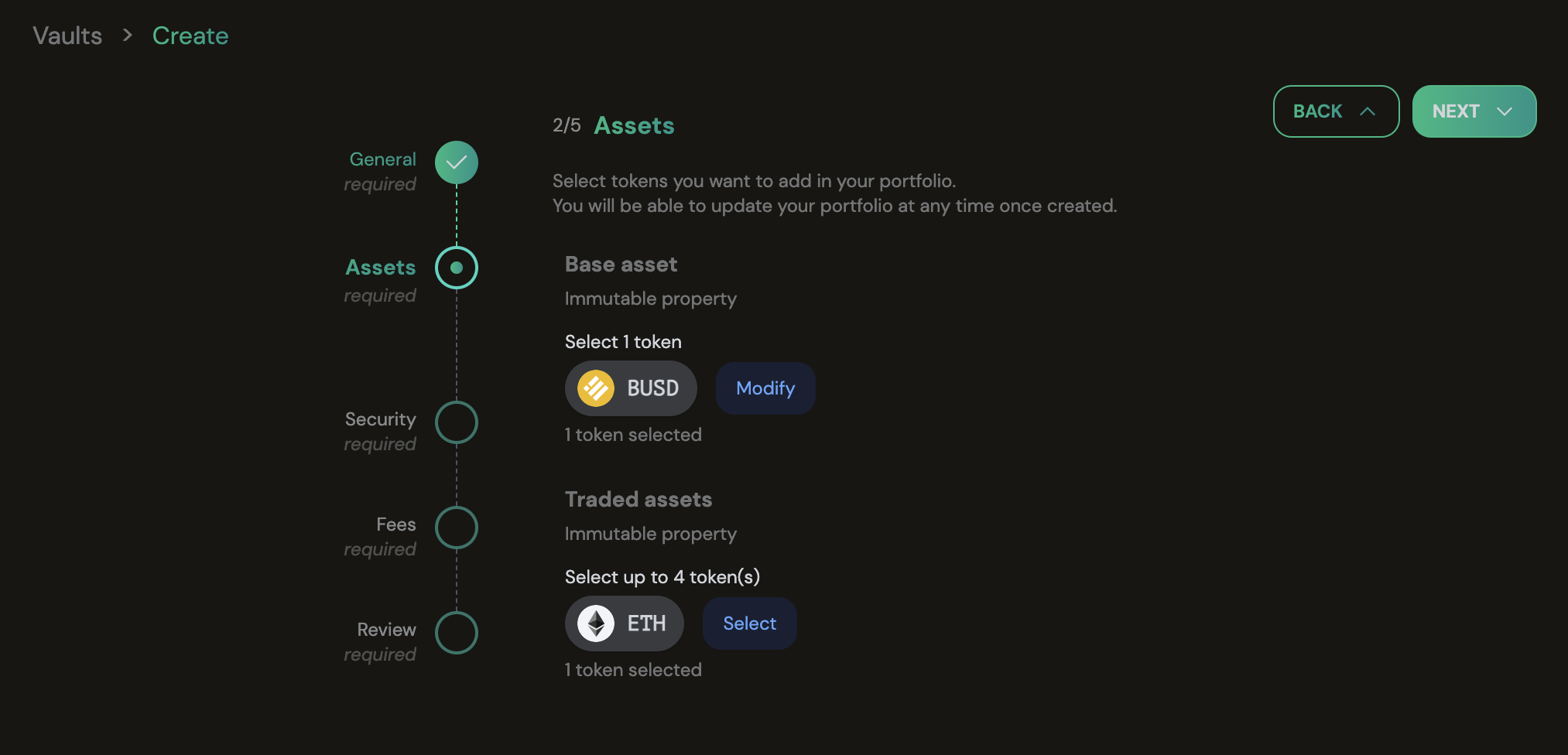
In the second section, you can choose the **assets** that will compose your vault. The **base asset** correspond to the asset that users will have to deposit to the vault whereas the **traded assets** corresponds to the assets will you be able to buy. In this example the BUSD is the base asset and the ETH is the traded assets.
Vault creation - Assets
This third section presents few parameters:
* **Maximum AUM** correspond to the maximum amount a vault can handle. In this example, once the vault reaches 10 000 US dollars, deposits will be disabled.
* **Minimum Deposi**t corresponds to the minium amount a user can deposit to a vault. In this example the user can not deposit any amount lower than $5.
* **Maximum Deposit** corresponds to the maximum amount a user can deposit to a vault. In this example the user can not deposit any amount greater than $100.
* **Minimum Frequency** swap corresponds to the minimum time to wait between two changements of exposition.
* **Maximum Loss Swap** corresponds to the maximum loss acceptable after a swap. Since you are trading on DEXs with large amount, **slippage and price impact** must be taken in consideration. Be sure to understand these concept before trading.
Vault creation - Security
This fourth section is focused on fees.
* **Beneficiary** corresponds to the address that will get fees generated by the vault
* **Exit fees** corresponds to the percentage a user will have to pay for redeeming.
* **Management Fees** corresponds to percentage users pay for using the vault. The value is indicated after 8 hours of managements and annually.
* **Performance Fees** corresponds to the percentage to pay from the performance generated by the vault
* **Management Fees To Strategist** corresponds to the part that will be received by the strategist from all management fees generated. In this example, the strategist will receive 50% from all management fees. The rest will be for the DAO.
* **Performance Fees To Strategist** corresponds to the part that will be received by the strategist from all performance fees generated. In this example, the strategist will receive 50% from all performance fees. The rest will be for the DAO.
After completing all parameters, the last section will resume everything and you will able to create the vault through your wallet.